Eurasian Pygmy Owl
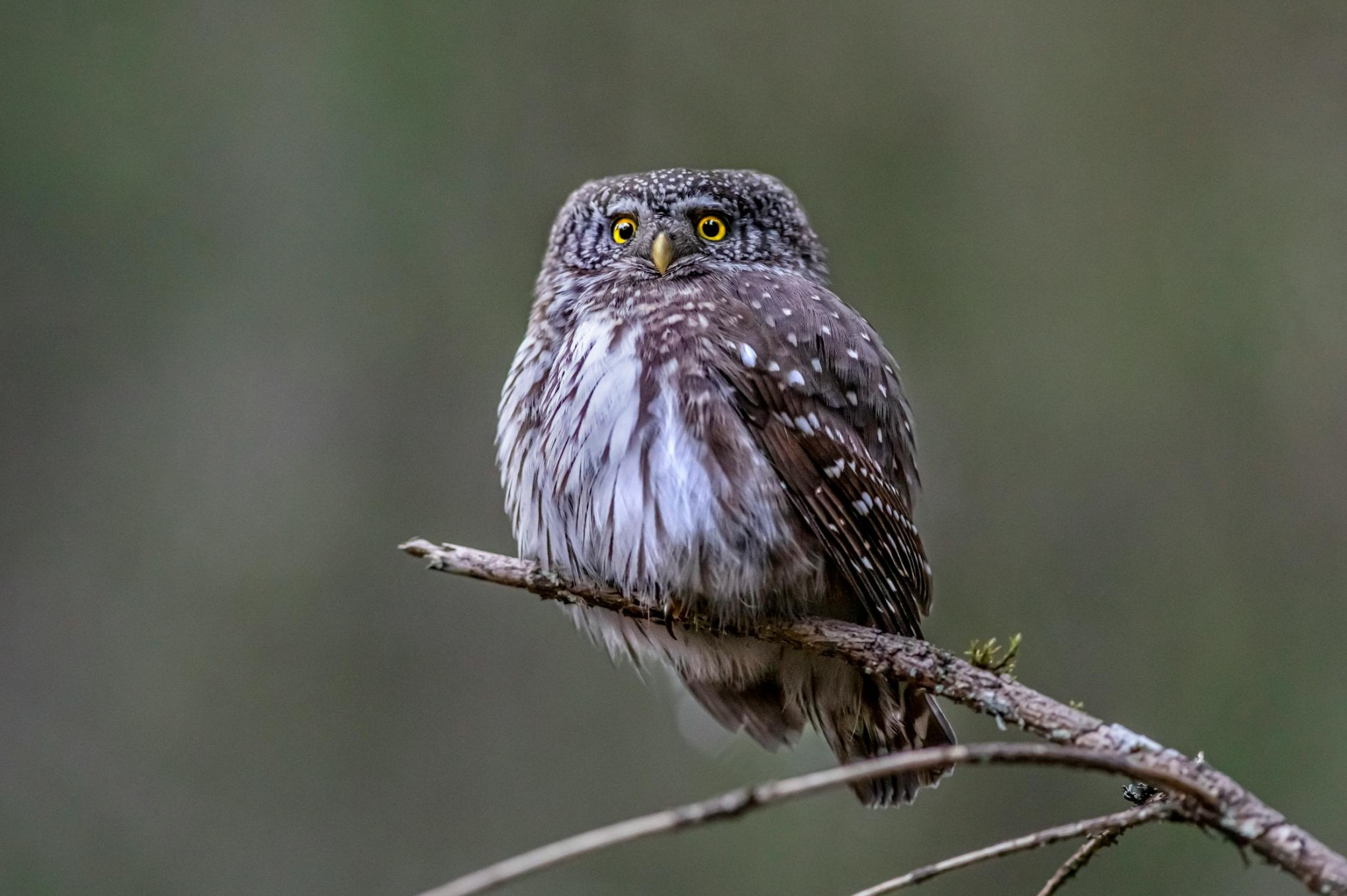
Overview: The Eurasian pygmy owl, Glaucidium passerinum, is the smallest owl in Europe. Adults are typically 15 to 19 cm in length, with a wingspan of about 32 to 39 cm and a body mass ranging from 50 to 80 g. Despite its size, it is a compact and efficient predator with a rounded head, bright yellow eyes, and a relatively long tail. The upperparts are brown with pale spotting, while the underparts are whitish with dense vertical streaking. A distinctive feature is the pair of pale spots on the back of the neck that resemble eyes and may function as a deterrent against predators. Females are slightly larger than males but otherwise similar in appearance. The species is a typical representative of the Strigidae family and is adapted to forest environments across the northern Palearctic.
Vocalisation: The species is most often detected by voice. The male produces a clear, repetitive series of flute-like whistles, each note evenly spaced and delivered with stable rhythm. These calls can continue for several minutes and carry over long distances in still forest air. Vocal activity peaks during the breeding season and is most common at dawn and dusk, although daytime calling is also frequent. Females vocalize less often and produce shorter, less regular sequences. In addition to the territorial song, the species uses contact calls, warning signals near the nest, and sharp alarm notes when disturbed. The ability to call in daylight distinguishes it from many strictly nocturnal owl species.
Distribution and habitat: The Eurasian pygmy owl is distributed across northern and central Eurasia, from Scandinavia and Central Europe through Russia to Siberia, with eastern populations reaching parts of Mongolia and northeastern China. It is strongly associated with boreal and montane forests, particularly mature coniferous stands dominated by spruce, fir, and pine, as well as mixed forests with sufficient structural diversity. The presence of tree cavities, especially those created by woodpeckers, is critical for nesting. The species occurs from lowland forests to mountainous areas up to around 2000 m above sea level. Most populations are resident, with only limited seasonal movements, although juveniles may disperse more widely after fledging.
Breeding: Breeding depends on the availability of natural cavities, as the species does not excavate its own nest. Egg laying typically occurs from April to May, depending on latitude and local conditions. Clutch size usually ranges from 3 to 7 eggs. The female incubates the eggs for approximately 28 to 30 days while the male provides food. After hatching, the female remains with the young during the early phase, and both parents later participate in feeding. Nestlings remain in the cavity for about 30 days before fledging. Post-fledging dependence continues for several weeks while juveniles develop hunting skills. Breeding success is closely linked to the abundance of small mammals, especially voles, and can vary significantly between years.
Food and feeding: The diet consists mainly of small mammals such as voles, mice, and shrews, but small birds are also frequently taken, including passerines up to the size of thrushes. Hunting is typically conducted from a perch, followed by a short, rapid attack. The species is active during daylight as well as twilight periods. A notable behavioral trait is the storage of prey in tree cavities and other sheltered locations. These food caches are especially important during winter and the breeding season, allowing the owl to maintain a stable food supply during periods of low hunting success. Prey remains and pellets containing fur and feathers are often found near feeding sites and provide evidence of the species' presence even when the bird is not directly observed.